
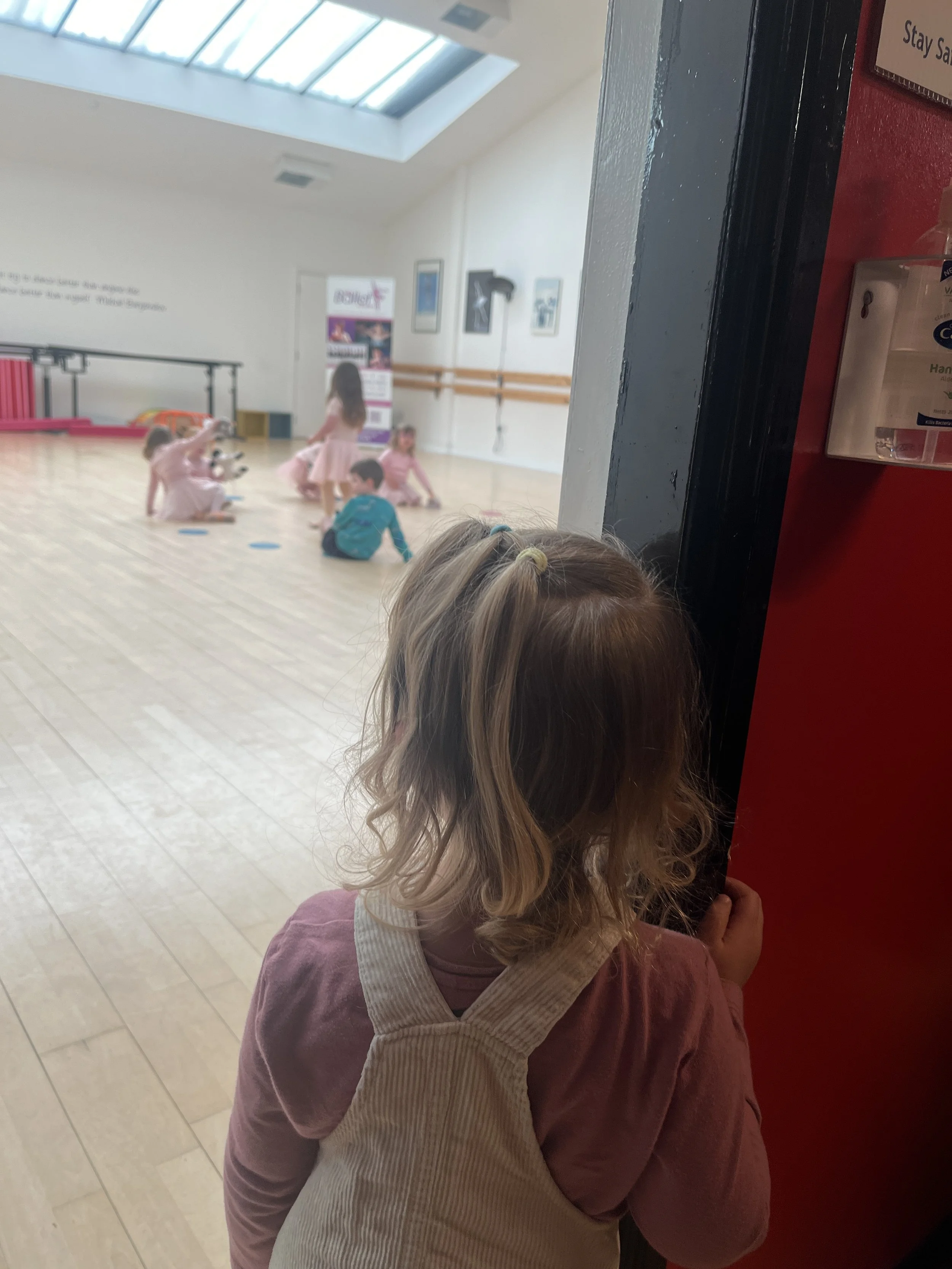
"She really wants to dance, but she's so shy. I'm worried she'll just stand at the side and not join in."
It's something we hear from parents quite often.
And if that's something you're wondering about, the first thing I'd say is:
Don't worry. We've got lots of experience with shy and nervous children, and you're very welcome to support your child while they settle in.
There isn't a particular way a child is expected to behave when they walk through our doors for the first time. Some children run straight into the studio without looking back. Others would quite happily stay attached to Mum or Dad for the entire first lesson!
And there is a whole range in between.
What does a shy child look like in a dance class?
There's no one version of "shy".
Some children cling to their parent when they arrive. Some don't want to come into the room at all. Some will come in but prefer to watch rather than join in. Others might join in happily but not want to speak to the teacher.
Some children might be perfectly happy once the class starts but become nervous again when something changes.
And sometimes you'll see several of these things happening at different times.
That's all OK.
Every child is different, and we don't expect them all to settle in at the same speed.
So what happens if they don't want to join in?
We don't force it.
Sometimes the best thing a child can do initially is simply watch.
Parents are welcome to come into the studio and support their child if they need that reassurance. Sometimes just knowing that Mum or Dad is nearby is enough to help them feel safe.
Our teachers also take time to get to know children who are nervous.
If we've met them before, we'll make sure we look out for them when they arrive. We might greet them at the door, introduce them to one of our younger assistants or give them some time to get comfortable without putting them under pressure to talk or make eye contact.
And sometimes, surprisingly, less is more.
A child who is nervous doesn't necessarily need a teacher constantly asking, "Are you OK?" or encouraging them to speak. Sometimes it's better to let them settle quietly, watch what's happening and join in when they're ready.
We give them time.
How long does it take?
This is probably one of the hardest questions to answer because every child is different.
Some children begin joining in during their very first class.
Others take a few weeks.
And for some children, it can take several months.
That's OK too.
We don't believe there is a deadline by which a child should suddenly become confident.
Sometimes the progress happens in tiny steps that a parent might not even notice at first.
Perhaps they stop looking back at Mum quite so often.
Then they smile.
Then they join in for one part of the class.
Then Mum moves back towards the waiting area.
And eventually, there comes that lovely moment when they walk into class independently and their parent realises they can leave.
Those little moments are huge.
One little girl who took six months...
I remember one little girl who was extremely attached to her mum when she first started.
She would cling to her and it took a long time for her to feel comfortable enough to participate independently.
It didn't happen quickly.
In fact, it took around six months.
But gradually, things changed.
She became more confident, built relationships with the teachers and other children, and eventually became so comfortable in the studio that she went on to become one of our teaching assistants, helping some of our younger dancers.
I think about her story quite often.
Because if we'd looked at her first few weeks and decided that dance "wasn't for her", we'd never have seen what she was capable of becoming.
Sometimes children just need time.
What about older children who are shy?
It's not just our youngest dancers who can feel nervous.
Older children can be shy too, particularly when they're joining a new class where they don't know anyone.
We make a point of welcoming them and introducing everyone at the start, and we encourage the other dancers to be friendly and supportive.
Our teachers are there to help them settle too.
And something lovely often happens when children realise that they don't have to be a "performer" to enjoy dance.
They can simply come along, learn, move, have fun and gradually become more comfortable in the group.
Does dance make a child less shy?
I wouldn't promise that dance is going to change a child's personality.
That's not really what we're trying to do.
For me, it's more about giving children a safe, supportive place to develop confidence at their own pace.
And when a child loves what they're doing, that can make a huge difference.
They have something they enjoy.
They learn new skills.
They build relationships.
They discover that they can do something that initially felt difficult.
And, over time, they can develop a real love of dance and a sense that the studio is somewhere they belong.
That confidence doesn't necessarily look like becoming the loudest person in the room.
Sometimes it's simply a child who was once too nervous to walk through the studio door now walking in with a smile.
And that's a pretty big achievement.
What can parents do to help?
The biggest thing I'd say is try not to worry too much yourself.
Children pick up on our worries, even when we're trying our best to hide them.
Talk positively about the class and let your child know that it's OK to feel nervous.
If they need you to come into the studio, come in.
If they need a little reassurance before class, give it to them.
And if they're ready to go in independently, let them take that step.
Once they're in the class, we do encourage children to join in rather than simply sit and watch. Sometimes that's the hardest part—but once they're involved, they often find it much easier.
And if you need to come back into the waiting area for a little while, we don't judge.
We understand.
We're parents too.
What happens during a two-week free trial?
Our two-week free trial can be particularly helpful for children who are nervous about starting somewhere new.
There's no expectation that they have to make a big decision straight away.
The first few classes give them the opportunity to meet their teacher, see how the class works, get to know the other children and gradually start to feel at home.
We also send a little welcome video from me when a new family registers for a trial, so your child has already seen a friendly face from the studio before they arrive.
And although we understand that a nervous child might want to watch at first, we'd much rather help them gently become involved than have them spend the whole class sitting on the side.
That's where the relationships start to grow.
So, should you bring your shy child to dance?
If they want to dance, then my answer is yes.
That's the important bit.
They don't have to be confident before they start.
They don't have to be outgoing.
They don't have to be a natural performer.
They don't have to walk into their first class with a huge smile and join in with everything straight away.
They just need to want to dance.
The rest is something we can work on together.
We love dance. We love teaching it. And we love seeing children discover what they're capable of.
So if your child is standing behind your legs right now, peeking out at the studio and wondering whether they can do it...
Come and let us help them take that first little step.
And if that first little step takes a while, that's OK too.
Still not sure?
If you're wondering whether your child would be comfortable at Alloa Ballet Company, please get in touch. Tell us a little about them and we'll be happy to talk things through.
All new students are welcome to take advantage of our two-week free trial, giving your child time to meet us, experience the class and begin to feel at home, with no pressure to get everything right from the very first day.